As with all site work the dangers of working with water and electricity pose severe threats to health if obvious and fundamental precautions are not taken. Therefore if you are in any doubt to any of the following, please do not hesitate to contact us.
All site work should be undertaken by qualified personnel only.
Tank Installation
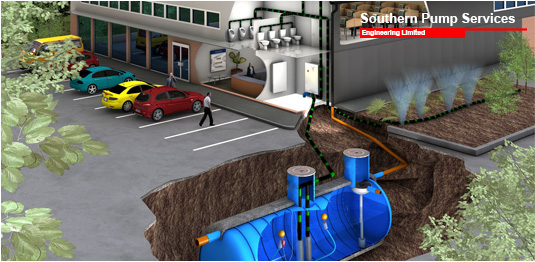
- Select a suitable location for the tank. This will be normally at ground level lower than the properties being drained and allow for the falls in site drainage.
- Check that no other structure – or special access – is required over the selected spot. Provision can always be made, if necessary, to place the tank on a roadway, provided that protective backfill is placed around it and a suitable heavy-duty manhole cover is used over the opening.
- Check that no underground cable, pipe or service duct, lies underneath.
- Excavate the minimum opening in the ground to receive the pumpwell and pipework to be used. If a machine is used to remove the spoil, the sides of the excavation should be battened for stability and a sump left in one corner for dewatering purposes.
- The depth of excavation needs to be at most 500mm deeper than the overall tank depth. If it is dug by hand, the sides will require shoring up for safety, to prevent earth slippage.
- A dewatering pump MUST be used to control any ground water present until the concrete backfill is set.
- Some clean hardcore should be placed and consolidated in the base of the excavation. Usually this will need to be about 200mm thick, but in good ground, should be a minimum of 50mm.
- Place in position the mass concrete base, minimum thickness 150mm of CP 20Kn/mm 2 strength.
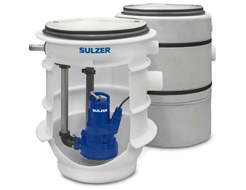
- Lower the pumpwell onto the damp concrete allowing the base flange, if fitted, to settle in, ensuring that the inlet and outlet pipes are correctly aligned.
- Place further mass concrete, as before, at least 150mm thick around the pumpwell to just below the level of the lowest inlet. Consolidate the concrete, being careful not to damage the tank or tank inlet/outlet pipes.
(The concrete backfill is designed to protect the chamber from external ground and water pressure. Therefore we cannot accept responsibility for damage to the chamber caused by ground or water pressure after installation.)
- Connect up the site pipework to the inlet and outlet of the pumpwell, and draw the pump and float cables through the conduit to the control panel.
- Backfill around the pumpwell with more concrete, remembering to fill the tank with clean water to overcome the effect of buoyancy.
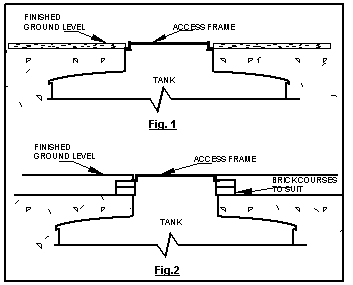
- Finish off the surface of the concrete at the required level, depending on the final ground cover required i.e. topsoil, tarmac, gravel etc